

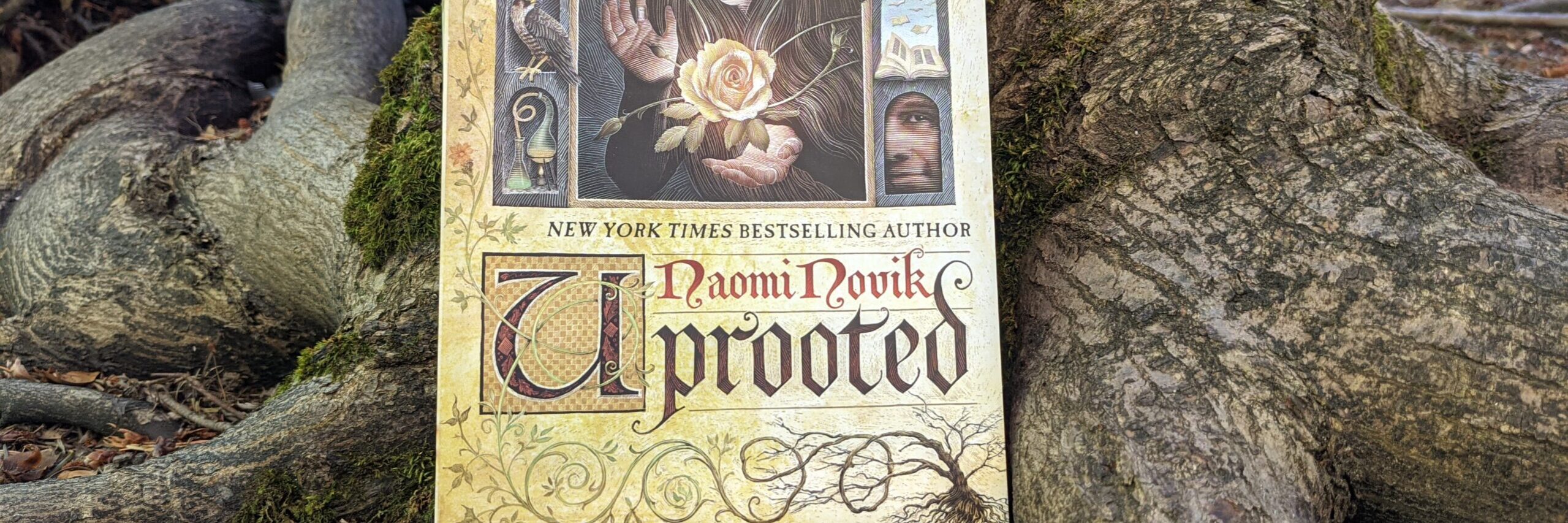
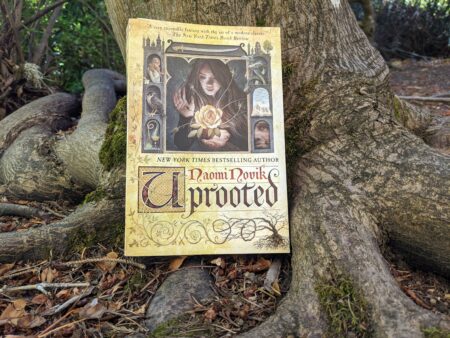
 Uprooted
Naomi Novik
The (a) story follows a young woman named Agnieszka, living in a small village near the border of a vile and corrupted Wood. Her people are kept safe from its dark magic by a local wizard who is known only as the Dragon. While Agnieszka loves her home, her happiness is overshadowed by a price the Dragon demands for his protection: every ten years, a young woman is selected from the valley to be locked away with him in his tower and work as his servant.
For Agnieszka’s whole life, the people in her village lived in the knowledge that, when the time of their choosing came, the Dragon would take her best friend Kasia: remarkably beautiful and elegant, and a stark contrast to Agnieszka, who has always been awkward and clumsy. But in an unexpected turn of events, the Dragon takes Agnieszka instead.
The Dragon is a cold, rude, and irritable man, and Agnieszka hopes to avoid him at all costs. But even in his obvious frustration at the mere sight of her, he continuously demands her time and energy, making her perform various spells that frighten and confuse her. But as time goes on within the tower, Agnieszka comes to learn that these spells are a result of her own magical talents, and even more slowly she develops an appreciation for the Dragon and his gruff mentorship.
But along the valley’s border, the dangers of the Wood are growing stronger.
The (A) story spreads in as many differing directions as the roots of a strong, old tree. While a general synopsis of the book would betray it as yet another retelling of Beauty and the Beast, there is so much more lying beneath the surface: not only romance, but tangles of folklore and themes as light-hearted as home and friendship, mixed with the heavier and darker truths of politics and corruption.
The most obvious theme within this story is corruption, which is embodied by the Wood itself—not so much a setting as it is a character of its own. Even within the Dragon’s protective spells, occasionally a horrible creature or substance will emerge within the valley, and any who have contact with it will become infested by the dark and angry spirit of the Wood.
But the corruption takes form in other ways, as is demonstrated by Prince Marek’s blind determination to save his long-lost mother from the clutches of the Wood. Despite the Dragon’s warnings and the impossibility of the task, he risks the lives of his men and the people of the valley by leading a charge within the heart of the Wood. And even after the horrific events that unfold from this, blind devotion continues to shake his rationality, and thus the rationality of other devotees within the royal court.
This arrogance demonstrates the politics of this world as well, which Agnieszka becomes all too familiar with when she heads to the capital. There, lords and ladies pretend to be your friend either for the sake of laughs or an ascension up the social ladder, and kings hold their own wives guilty of treason for the sake of ridding themselves of an anachronistic partnership. Even those lucky enough to escape that environment are still haunted by its reach, as the Dragon is when he, at first, suspects Agnieszka of being a spy and saboteur.
In a way, the politics of the capital is not unlike the corruption of the Wood.
Yet there are overhanging lights within this darkness. One comes in the form of pure, undying friendship, which is demonstrated by the bond between Agnieszka and Kasia. Raised together under the threat of the Dragon’s decennial demand, Agnieszka clings to Kasia in a way others refuse to—even her own mother—because of the knowledge that she will surely be taken from them. And even as the switching of each other’s fates drives feelings of confusion and bitterness between them, they are forced to face the rift and meld it, especially as Agnieszka risks her life for Kasia’s time and again. And this love and loyalty displayed by Agnieszka is returned tenfold once Kasia comes into her own unique and unexpected power.
But another of the subtler themes from this story is the concept of home and a sense of being bound, heart and soul, to a specific place. This is something the Dragon refuses to allow for himself—staying locked up in his tower and shying away from celebrations and gatherings—and something that Agnieszka knows well, growing up within the hideous shadow of the Wood, and yet not possessing any longing or drive to leave. This concept of “putting down roots” is repeated frequently throughout the book, and nears its full circle as Agnieszka comes to terms with her bond to the valley, and begins to wonder what it means for her future with the Dragon, who recoils from the mere thought of putting down roots of his own.
On the back cover of my copy of Uprooted, NPR is listed among the favorable reviews of the book, with the conclusion: “Clear your schedule before picking it up, because you won’t want to put it down.” And they are correct to warn you. I love this book. I adore it. And on my first time through I could not stop reading it; every spare moment, and some moments that weren’t so spare, I had my nose buried in it. Even now, unnecessary hours have ticked by for this review because every time I skim through the book for a specific reference I find myself reading, yearning to be lost between the covers once again.
Despite the frightfully haunting and gruesome aspect of the Wood, I am reluctant to leave these characters and their world. Even the Dragon, who immediately strikes a reader as cuddly as the mythical monster for which he was named, grew on me. His tactless criticisms and insults somehow became endearing the more I learned about him and the more chances he took to redeem himself through Agnieszka’s friendship. Soon I found myself missing his company and frightened for his safety, and grateful almost to tears whenever things turned out okay.
Uprooted has earned a place as one of those favorites I intend to read over and over again. Every aspect of this story is enchanting, haunting, and poignant; it is a definite read for any dreamer who can endure a little darkness for the sake of the light.
Just be aware that it will quite possibly take root in your heart.

I very much enjoyed reading Uprooted! And as you and NPR stated, I also did not want to put it down once I started it. I’m glad to get your insightful perspective on this story and I am inspired to pick it up again sooner rather than later for a reread! As I was reading the story, I began to discover that the title itself had so much more meaning than I first thought. Your review of this book helped me to remember that there is so much more to Uprooted than I initially noticed, which is probably why it was so hard to put it down.
Thank you for your insightful, well written review of Uprooted. You’ve pointed out the intricacies and helped me to understand and appreciate it so much more than I already did 🙂
Thank you, Care Bear! I’m so glad you enjoyed it. It is definitely one of my new favorites 😀😀😀