
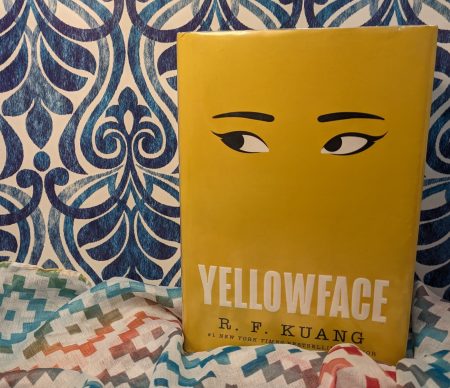
 Yellowface
by R.F. Kuang
The (a) story follows two different writers aiming to make their mark on the book industry. Athena Liu is a rising star in the literary field: with several acclaimed and award-winning stories under her belt, and even a Netflix deal on the way, Athena has the kind of life every aspiring author would sell their soul to have. June Hayward, however, is the opposite. With one major flop, no prospects, and a publishing team that doesn’t even seem to like her books let alone intend to help her sell them, June has the kind of life most aspiring authors actually live. Broke, processing feelings of abandonment and invisibility, and living in Athena’s shadow to top it all off, June maintains a “friendship” with her prodigious peer while simultaneously harboring feelings of jealousy and resentment toward her.
But then June watches Athena die in a freak accident. And a brilliant manuscript that no one knows exists is sitting right there on her desk.
When June, a white woman, passes off the magnum opus of an Asian American author exploring the untold stories of Chinese laborers during World War I as her own, she sets in motion a train of lies and moral justifications that at any moment could be derailed. And as the lies begin to multiply, and her actions become even harder to justify, it becomes clear that there are a number of certain lines June Hayward is willing to cross in order to hold on to her newfound praise and acclaim.
The (A) story covers a lot of ground. The most prominent themes of the book have a clear focus on racism, misappropriation, and representation—especially within the realm of publishing. But the book also leans into the harassment, toxicity, and the anxiety-inducing vitriol of social media, and how no one is ever entirely a saint or a sinner in the things they do to make their way in this world. As well as that, this book has a lot to say in terms of the pressures and moral ambiguities, as well as the moral failings, of the publishing industry in general.
This book is…exhausting. But in a good way.
I first picked it up at the recommendation of a friend, and though I’m normally more of a fantasy / sci-fi / adventure reader than a contemporary reader, I was nevertheless intrigued by the synopsis. I will say I was very grateful to step into this book knowing it was a satire right from the get-go (although, I’d like to think the absolutely ridiculous death of Athena would have clued me in to that fact eventually), because I might have found it an extremely difficult read otherwise.
This is due in large part because the main character is awful. And we’re stuck in her narrative stream-of-consciousness for the entire novel. Like I said: exhausting. But that’s why going into it knowing it was kind of supposed to be exhausting was helpful. One of the authors quoted on the back cover compared the book to riding a roller coaster with no seatbelt on, and I very much have to agree with that statement. There were moments I found myself—none too enthusiastically, I might add—strongly identifying with the unlikeable June Hayward in more ways than one, but there were also moments I found myself cringing at her micro-aggressions and extremely distasteful choices. I also found a whole heap of affirmation for my hesitancy to go into traditional publishing. Because, frankly, that sounds like hell.
All-in-all, this book was a wild ride. And what I enjoy and admire the most about it is the fact that it really doesn’t end with a clear moral lesson that wraps everything up and leaves the reader feeling satisfied. Instead, it forces its audience to sit quietly for a moment afterward, questioning their own morals and the morals of those outlets controlling the narratives of their lives—be they influencers on social media or giants in the publishing industry.