Callum Quinn, © 2021
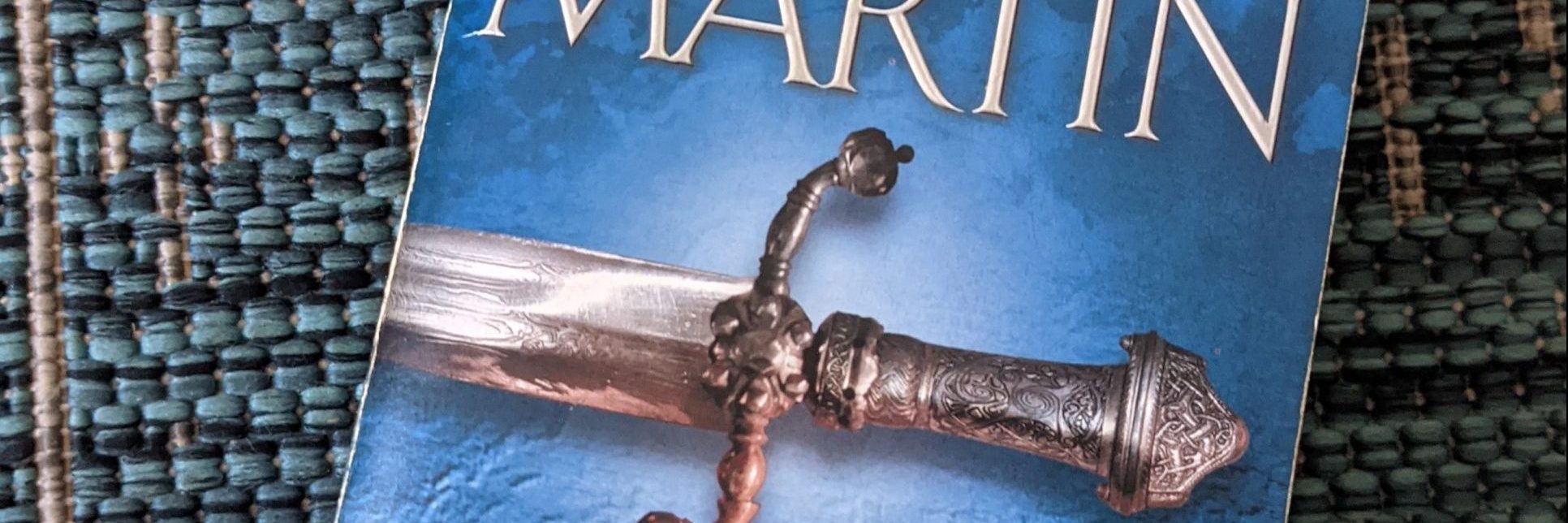
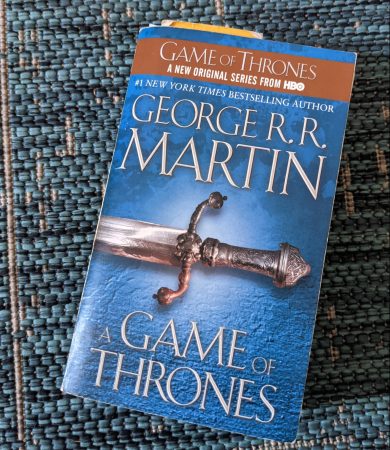
A Game of Thrones
By George R.R. Martin
For the few out there who are still unfamiliar with the popular HBO television series and the books that inspired it, the (a) story of A Game of Thrones is in the title. Wars have come and gone within the Seven Kingdoms of Westeros; a king sits upon the Iron Throne, a conquered heir is exiled to a faraway land, and beneath the surface trouble is steadily brewing. Within the kingdoms, some vie for control. Others fight to keep the peace, and even more demand justice. But all of them—be their intentions secretive, villainous, greedy, or honorable—are forever locked into a string of events that will separate families, bury good men and women, and plunge the kingdoms into chaos as they compete in a deadly game for the throne.
But the worst is yet to come, for far in the north another danger is steadily growing. Winter is coming, and it brings with it something far more sinister than war and politics.
The (A) story is very much about power. But it is not simply the power that comes with the throne; one thing to note about the series—whether you’re watching the show or reading the books—is that there is no real line drawn between the “good” side and the “bad” side. Each party has their own delicate mixture of scoundrels, heroes, and just plain psychopaths. And each party has their own ways of expressing the power that they have at their disposal. Eddard Stark, for example, expresses his power through a sense of honor and duty; Joffrey Baratheon expresses his power through cruelty. And then there are those like Tyrion Lannister who—born with neither the stature nor the general skills needed to excel in this harsh world—has to rely on his mind and his money to survive.
But the book also has much to say about how power is distributed—and what that means for everyone under the thumbs of those in charge. This is most clearly stated through Lord Varys’s question to Ned: “Why is it always the innocents who suffer most, when you high lords play your game of thrones?”
But this distribution of power is also explored through the viewpoints of those in the Night’s Watch—a military group made up of criminals, exiles, and misfits who have been granted a second chance at life by guarding the Seven Kingdoms from threats to the north. As is stated in the vows they make upon taking the watch: they “shall wear no crowns and win no glory.” Their loyalty is to the realm, and to no one else—not even family. And they are required to take this vow, to make these sacrifices, because for centuries the Night’s Watch has been all that stands between the Seven Kingdoms and the dangers of the north.
However, the Night’s Watch is now only a shadow of what it once was. And even as the darkness grows stronger in the north, their pleas for more manpower go blatantly ignored by those whose support could make all the difference. As Lord Mormont confides to young Jon Snow, the Night’s Watch seems to “count for less than nothing” among those in King’s Landing. And yet the threats in the north will eventually affect everyone who lives within the realm, not just those closest to the danger; the unfortunate reality is that those who hold all the power seem unconcerned by that fact, with some even appearing to doubt the threat entirely (Sounding a bit familiar?). Yet, as Mormont concludes: with such a terrible darkness looming on the horizon, “do you think it matters who sits the Iron Throne?”
Within this same strand of thought it could be argued that the story also has something to say about working together as a society (or, in this case, a kingdom), instead of fighting amongst ourselves. For all the backstabbing and the emphasis placed on the warring sides within this book, there are an equal number of moments that demonstrate the dangers of such discord. As mentioned above, Lord Mormont’s speech to Jon brings our attention to this fact. But there is also a moment in which Ned tells his rebellious daughter Arya, using their house symbol of the dire wolf as an example, that “When the snows fall and the white winds blow, the lone wolf dies, but the pack survives. Summer is the time for squabbles. In the winter, we must protect one another, keep each other warm, share our strengths.”
Finally, there are plenty of examples of strong female characters within this series. At the forefront is Arya Stark, who absolutely refuses to become the “lady” that she is expected to be—preferring swords and sparring to needles and thread. But we can also see great leadership and critical thinking skills paired with a more traditional lady-like strength in the form of Catelyn Stark, who diligently guides her eldest son as he goes off to war for the first time in his young life.
And then there is Daenerys Targaryen, the exiled heir to the throne who has found herself thrust into a world of men. We can see her growth as a woman from the moment she first stands up to her cruel brother Viserys, realizing at last that “he was a pitiful thing. He had always been a pitiful thing,” to the moment she says my favorite line from the book—when the mighty but wounded Kal Drogo snaps to his fellow warriors that he “need[s] no man’s help,” and Dany replies: “I am no man, so you may lean on me.”
Yet, we are also given a glimpse into a dark, alternative perspective to femininity with young Sansa Stark, who repeatedly suffers at the hands of a patriarchal society—and yet cannot shake the lessons in smiling and nodding and doing as she’s told that have been drilled into her head since birth. Once again, for every moment of light within this book, Martin throws in a touch of darkness. And I, for one, can’t wait to see how and when Sansa finally rises to fight her oppressors as the series moves on.
I was first introduced to the world of Westeros when I started watching the HBO series—about ten years behind the hype, as I tend to be with pop culture. And I was immediately hooked. However, I am aware that even before the dreaded final season the show started to deviate from the books. So I am curious to complete the series as George R.R. Martin envisioned it.
Except for a few moments when the setting descriptions seemed to get a little long-winded, A Game of Thrones is raw and powerful and full of memorable characters and situations. I would highly recommend it, especially if you are hesitant to watch the show due to the graphic violence and sexual content; for the first book, at least, you get pretty much the same great storyline and characters with significantly less of an R rating.
Ten out of ten for fantasy!